Table of Contents
Protecting Your Trees with Cabling and Bracing in Northwest Louisiana
When a tree’s structure is compromised by storms or age, cabling and bracing can be the intervention that saves it. For property owners in Northwest Louisiana, where tropical storms and high winds routinely test the limits of mature hardwoods and ornamental trees alike, proactive structural support is often the wisest investment in long-term landscape health. Our certified arborists frequently evaluate trees that appear healthy on the outside yet harbor weak branch unions, codominant stems, or internal decay that only professional assessment can detect. Installing cabling and bracing for trees before failure occurs can prevent property damage, extend the life of valuable shade trees, and avoid the sudden loss of irreplaceable landscape features.
Dynamic tree cabling uses flexible synthetic straps that allow a controlled range of natural movement while reducing the risk of branch or trunk failure during severe weather. In contrast, rigid bracing employs steel rods to stabilize existing cracks and splits, reinforcing compromised wood so the tree can continue compartmentalizing decay on its own. Both methods require precise placement and ongoing monitoring — work that should only be performed by certified arborists on staff who understand the biology, load dynamics, and species-specific growth patterns of the trees they support. When installed incorrectly, cables and braces can girdle bark, create stress points, or give a false sense of security that leads to worse damage later.
At Miller Tree Service, we have delivered reliable tree stabilization solutions for over 40 years serving Northwest Louisiana. As a local, family-owned and operated company, fully licensed and insured, we approach every cabling and bracing recommendation with the same care we would apply to trees on our own property. Our team brings an A+ rating with the BBB and four ISA-certified arborists to every site visit, ensuring you receive a recommendation grounded in genuine expertise rather than guesswork. Each tree is unique, which is why we never provide generic pricing for cabling and bracing — structural needs vary widely based on species, age, condition, and risk factors. Schedule a certified arborist consultation to receive a detailed written assessment and a custom-quote plan designed specifically for your property. If a tree cannot be saved through cabling or bracing, removal may be the safest option — covered in the next section.
Understanding Tree Cabling and Bracing Fundamentals
As a local, family-owned and operated tree service, we understand the deep connection property owners have with their mature trees. When a beloved tree develops structural weaknesses, the decision to preserve it often leads to exploring specialized support systems. This is where cabling and bracing for trees becomes an essential consideration. These structural tree support systems are designed to mitigate the risk of failure in trees with compromised integrity, helping to extend their lifespan and maintain the safety of your landscape.
To understand how these systems work, let’s explore the fundamentals. Tree cabling and bracing are two distinct but complementary methods used by arborists to provide supplemental support. Cabling typically involves the installation of flexible, high-strength steel cables in the upper canopy of a tree. These cables are attached to major limbs to create a network that limits excessive movement and reduces the stress on weak branch unions during high winds, ice storms, or heavy rains. Bracing, on the other hand, uses rigid steel rods inserted directly through the wood of a split or cracked crotch. The rod physically binds the compromised area, preventing further splitting and allowing the tree to compartmentalize the wound. While these tree bracing techniques can be highly effective, they are not a cure-all; a tree with significant internal decay may require more comprehensive intervention.
When is cabling and bracing for trees necessary? There are several common scenarios where our certified arborists might recommend these support systems. One of the most frequent indicators is the presence of co-dominant stems, where two or more similarly sized limbs arise from a single point, forming a weak, V-shaped union with included bark. These unions are structurally prone to splitting as the tree matures. Other situations include heavy, overextended lateral limbs that are susceptible to torsional failure, trees that have suffered stress cracks or partial splits from storm damage, and older trees with historical structural defects that are otherwise healthy and highly valued by the property owner. In each case, the goal is to reduce the risk of catastrophic limb or trunk failure.
Modern approaches, such as dynamic tree cabling, offer a more holistic method than the rigid systems of the past. A dynamic system uses a combination of flexible synthetic rope and shock-absorbing components, allowing the tree canopy to experience a more natural range of motion while still providing critical restraint during extreme weather events. This encourages the tree to continue developing reaction wood—its own natural support tissue—making it stronger over time. Regardless of the system used, it is crucial that installation is performed by a fully licensed and insured professional. Improperly installed hardware can girdle a stem, introduce decay, or fail catastrophically. With over 40 years serving Northwest Louisiana, our team has the deep regional experience to know how local species like water oaks and pecans respond to structural threats and support systems.
It is important to understand that tree cabling and bracing are not a one-time, permanent fix. A cabled or braced tree becomes a managed tree, requiring periodic inspection by an arborist to ensure the hardware remains functional, has not been enveloped by new wood growth, and that the tree’s condition has not declined. This ongoing care is a small investment that can add decades to the life of a treasured tree, preserving not only its shade and beauty but also the up to 20 percent of home value that healthy, mature trees can contribute to a property. When considering tree cabling and bracing cost, it’s vital to know that every situation is unique and requires a custom assessment; we provide personalized, no-obligation quotes because a mature tree’s structural integrity cannot be evaluated with a one-size-fits-all approach.
If you have a tree with a split crotch, co-dominant stems, or heavy limbs that cause you concern, professional intervention can make all the difference. For a thorough evaluation and a custom preservation plan, schedule a certified arborist consultation with our team to determine the most effective strategy for your tree’s health and your property’s safety.
Dynamic Cabling vs. Traditional Bracing: Choosing the Right Approach
When evaluating cabling and bracing for trees, property owners must consider two primary approaches, each designed to address different structural weaknesses and long-term goals. As a fully licensed and insured, family-owned operation with over 40 years serving Northwest Louisiana, we help you understand these systems so you can make the best choice for your landscape. The right decision starts with an understanding of how dynamic and static systems function, and when each is recommended to reduce risk without making any guarantee of survival.
Dynamic Cabling Systems: Flexible Support for Growing Trees
Dynamic tree cabling uses synthetic ropes, typically made of high-strength polyester, installed in the upper canopy to create a flexible, non-invasive support network. Unlike rigid systems, this approach allows the tree to continue its natural movement, swaying with the wind rather than fighting it. This movement is essential for building reaction wood—the tree’s own strengthening tissue—so the tree can gradually reinforce its structure over time.
We recommend dynamic cabling for valuable specimen trees showing moderate structural risk, such as those with co-dominant stems or included bark formations that might fail in severe weather. The synthetic rope is installed without drilling through the trunk, which helps preserve the tree’s natural defenses against decay and pathogens. The system acts as a shock absorber, distributing loads evenly when gusts hit, and our certified arborists are trained to place the cables precisely where they will do the most good.
In the Northwest Louisiana climate, where storm events can stress mature oaks and pines alike, dynamic supports typically last 5 to 10 years depending on material wear and exposure. Regular monitoring by a professional ensures the system remains effective and that the tree is responding as expected.
Traditional Static Bracing: Rigid Protection for Weak Unions
For trees that pose a more immediate hazard, a traditional static bracing system provides rigid steel support. This method uses galvanized steel cables and threaded rods, often drilled directly through the trunk or major limbs, to lock a weak union into a fixed position. The rigid steel support eliminates movement at the defect point, which can be crucial when a split or crack threatens to propagate quickly.
Static bracing is typically reserved for high-risk scenarios—trees with visible cracks, advanced decay pockets, or a severe lean that demands an uncompromising hold. The installation is more invasive, requiring precise drilling by an experienced professional to avoid damaging living tissue unnecessarily. A static system can last 10 to 15 years but demands periodic inspection to check for corrosion, loosening hardware, or girdling effects as the tree grows around the brace.
Our team has installed countless static bracing systems across the Shreveport and Bossier City areas, always starting with a thorough assessment to determine whether the tree’s structural integrity can be sufficiently improved without compromising its long-term health.
Choosing Between Dynamic and Static Systems
When we evaluate a tree, we consider its species, age, specific defect, and the owner’s long-term goals. For example, a mature oak with a narrow crotch but no active splitting may benefit from dynamic cabling that allows it to continue strengthening naturally. In contrast, a storm-damaged tree with a fresh, spreading crack that threatens an immediate failure scenario may need the rigid hold of a static brace for risk reduction.
Our comparison table below summarizes the differences to help you understand the trade-offs before our team arrives on site.
Dynamic Cabling vs. Static Bracing Comparison
| Feature |
Dynamic Cabling |
Static Bracing |
| Material |
Synthetic rope (e.g., polyester) |
Galvanized steel cable |
| Flexibility |
Allows natural tree movement |
Rigid, restricts movement |
| Installation difficulty |
Moderate; requires careful placement |
High; drilling often required |
| Typical lifespan |
5–10 years depending on material |
10–15 years, but needs periodic inspection |
| Best suited for |
Trees with moderate structural risk, valuable specimens |
High-risk trees, immediate hazard reduction |
Professional arborist assessment is required before any installation. Miller Tree Service offers both options with certified arborists.
Every tree presents a unique challenge, and the decision between these two systems is never one-size-fits-all. Your tree’s condition and your priorities as a property owner drive the recommendation. For personalized advice on which system best suits your tree, schedule a certified arborist consultation with our team. Your certified arborist will walk you through the full installation process during a consultation, answering questions about maintenance, what to expect over time, and how we manage the work safely with our trained crews and equipment.
Deciding When to Cable or Brace Your Trees
Based on the condition of your tree, the next step is deciding whether cabling and bracing for trees is the right choice. This decision can feel overwhelming, but understanding a few key indicators can help you make an informed choice that protects your property and preserves your landscape. Our team at Miller Tree Service is here to guide you through this process with professional assessments and clear, honest recommendations.
Assessing Your Tree’s Condition and Risk
A thorough visual inspection is the first step in determining if a tree is a candidate for support systems. We look for several critical warning signs that indicate structural weakness. A large crack running down the trunk or through a major limb is an obvious red flag. Similarly, a branch union that forms a tight V-shape, often called a weak crotch, is a common failure point as the tree grows and the two stems push against each other. Sometimes, the defect is more subtle, such as a new and moderate lean, which can signal root damage or soil instability that requires immediate attention.
Not every defect is a disaster. For trees in good to fair health, a single crack or a weak branch attachment can often be stabilized with the right technique. Dynamic tree cabling, for instance, is a newer approach that allows for more natural movement while still restricting dangerous motion. This method can be particularly effective for certain types of cracks. However, your tree’s overall vitality and the local environment are major factors. Tree species common in Northwest Louisiana, like oaks, can be susceptible to internal decay even if the canopy looks healthy, which is why an arborist’s trained eye is essential. If you spot any of these problems, it’s time to call a professional rather than attempting a DIY fix.
Understanding Costs and Consultation Process
A question we often hear is about the tree cabling and bracing cost. There is no standard price list because every situation is unique. The cost to install a structural support system in a large tree is a custom quote based on a specific set of variables. We evaluate the tree’s size and location, the severity and number of defects, and the complexity of accessing the canopy safely. This ensures you pay only for the precise work your tree needs, not a one-size-fits-all package.
Our process begins with a free, no-obligation consultation at your property anywhere in Northwest Louisiana. One of our certified arborists will perform a comprehensive on-site assessment, examining the tree from the roots to the crown. We will explain our findings in clear terms, discuss whether your tree is a good candidate for a structural cable installation or another form of support, and provide a detailed, written estimate. With over 40 years of serving our region and an A+ rating with the BBB, our fully licensed and insured team brings honest, expert guidance to every job.
When to Remove vs. Brace: A Decision Framework
Making the final call between preservation and removal often comes down to a few critical factors. Generally, we recommend you brace a tree if it is healthy and the structural defect is repairable; this approach is a long-term investment in a valuable landscape asset. Removal is the safest and most appropriate course when the tree’s structure is too compromised, perhaps from a large split or a severe lean greater than 30 degrees, or if the tree is already in a state of decline and the risk of failure is unacceptably high. The following matrix provides a quick-reference guide to the key factors in this decision.
Brace vs. Remove Decision Matrix
| Factor |
Brace/Cable |
Remove |
| Tree health |
Good to fair |
Poor, declining, or dead |
| Structural defect type |
Single crack, weak crotch, moderate lean |
Large split, compromised trunk, severe lean >30° |
| Target value |
Specimen tree, shade value, sentimental |
Invasive species, undesirable location |
| Proximity to structures |
Low risk if failure occurs |
High risk to house, road, playground |
| Cost consideration |
Long-term investment in preservation |
Upfront removal cost; no ongoing |
| Outcome |
Tree survives with periodic maintenance |
Tree is replaced; risk eliminated |
This table offers a starting point, but no two trees are exactly alike. A beautiful oak shading your home might be a perfect candidate for cabling, while the same species in a different location, actively dying, would pose a significant hazard that requires removal. Ultimately, a definitive decision must be confirmed by a certified arborist after an in-person evaluation. Our team at Miller Tree Service provides free consultation to help you weigh these factors with confidence.
Once you’ve determined that bracing is the right move, our certified arborists will handle the installation with precision, using proven techniques to give your treasured tree a new lease on life. We are proud to serve as your local, family-owned and operated tree care experts, available 24/7 for emergency service and dedicated to being professional and respectful on every property we visit.
Installation, Inspection, and Maintenance of Tree Support Systems
Proper installation, regular inspection, and ongoing maintenance are essential for the effectiveness and safety of cabling and bracing for trees. These structural support systems require professional expertise to ensure they protect your property without compromising tree health.
Installation
We distinguish between two primary methods: cabling provides flexible support that allows a tree to move naturally in the wind, while bracing offers rigid reinforcement using steel rods through weak unions. For dynamic tree cabling, our certified arborists install cables approximately two-thirds of the way up from the defect, a standard that maximizes leverage and support. We use industry-approved hardware such as J-bolts and lag hooks, carefully tensioning the system to permit natural, dynamic movement. Every installation strictly follows ANSI A300 standards, a critical protocol that, according to our team at Miller Tree Service, prevents the severe damage that can result from improper techniques.
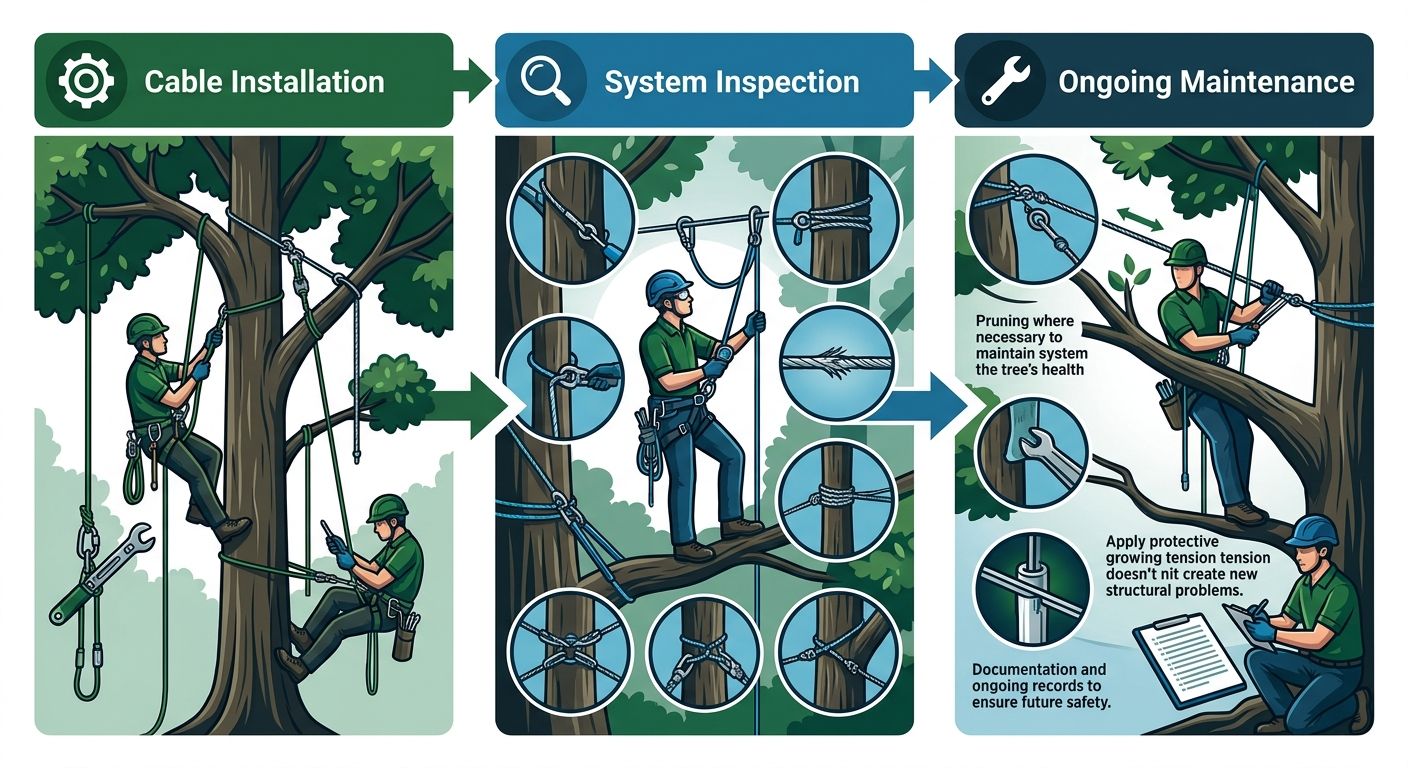
Three-stage tree support system process flow
Inspection
We recommend a thorough inspection of your tree support systems at least annually and immediately after any major storm event in Northwest Louisiana. During these evaluations, our arborists meticulously check cable tension, examine bark and tissue around attachment points, and look for signs of hardware corrosion or failure. We also assess how the tree’s new growth is interacting with the system. This professional oversight is vital, as the supporting hardware can become embedded in the trunk or fail over time, creating new hazards rather than mitigating existing ones.
Maintenance
The ongoing maintenance of cabling and bracing for trees includes periodic retensioning and the replacement of worn cables or corroded hardware. As the tree grows, we may need to adjust or expand the system to address new structural defects or areas of decay. Our team of four on-staff arborists ensures that all service is performed by certified professionals, not general laborers. As a local, family-owned and operated company, we are fully licensed and insured and have proudly maintained an A+ rating with the BBB throughout our over 40 years serving Northwest Louisiana. For tree cabling and bracing cost, the investment depends on specific factors like tree size, the number of cables required, and site accessibility. We provide a custom quote after a complimentary on-site consultation, ensuring you get an accurate picture of the project. Contact our team for a custom quote on your tree support system needs.
Frequently Asked Questions About Tree Cabling and Bracing
Still have questions? Here are answers to common inquiries about our cabling and bracing services. As a local, family-owned company, we’re committed to helping you make informed decisions about your trees.
What is tree cabling and bracing?
Tree cabling and bracing is a support system used to reinforce trees with structural weaknesses. High-strength cables and braces are installed to limit branch movement and reduce the risk of failure, helping to preserve the tree’s health and safety.
When is tree cabling recommended?
Cabling and bracing for trees is recommended when a tree has weak branch unions, heavy or over-extended limbs, or has suffered damage from a storm. Our certified arborists assess each situation to determine if a support system is the right solution.
How is tree cabling installed?
We use dynamic tree cabling systems to provide flexible support that allows trees to move naturally while limiting the risk of breakage. The installation involves placing cables and braces high in the canopy, which should only be done by trained, certified arborists for safety and effectiveness.
Is tree cabling a permanent solution?
Cabling is not a permanent fix but a long-term support measure that requires periodic inspections to ensure the system remains effective. With proper maintenance, it can significantly extend the life of a valuable tree and improve safety on your property.
How much does tree cabling and bracing cost?
Because every tree and situation is unique, we create personalized quotes after an arborist assessment. We don’t use a one-size-fits-all pricing structure, so the best way to understand your tree cabling and bracing cost is to contact us for a no-obligation estimate. We’re fully licensed and insured, with over 40 years of experience serving Northwest Louisiana, and we’re ready to help.
Secure Your Landscape with Professional Tree Support
When structural weaknesses threaten your trees, cabling and bracing for trees provides essential supplemental support to protect your landscape. We install these systems on specimens with split crotches, heavy limbs, or storm-related stress, using dynamic tree cabling to allow natural movement while reducing load on vulnerable branch unions. As a fully licensed and insured, family-owned and operated company with over 40 years serving Northwest Louisiana, our certified arborists ensure every installation meets the highest safety standards. If you need immediate assistance, our 24/7 emergency service is always available—call us for a custom quote on affordable bracing solutions.
Resources