Table of Contents
Understanding Certified Arborist Consultation in Shreveport, Louisiana
Beyond general tree care, a certified arborist consultation provides the expert-level insight every property needs. A certified arborist consultation in Shreveport begins with a detailed on-site inspection by one of our four ISA-certified arborists, all fully licensed and insured. Unlike a general tree trimmer, a certified arborist has completed formal training and ongoing education to evaluate tree health, structural integrity, and hidden risks. The consultation includes a thorough tree risk assessment that identifies weak branches, decay, or root issues, as well as a comprehensive tree health assessment covering soil condition, nutrient needs, and disease diagnosis. Because Shreveport’s humid subtropical climate encourages rapid growth but also fungal issues in pines, oaks, and pecans, our arborists tailor their evaluations to Northwest Louisiana’s specific challenges. With over 40 years serving Northwest Louisiana and an A+ rating with the BBB, we bring proven reliability to every visit. While we serve all of Northwest Louisiana, including an arborist in Benton, this guide focuses on what you can expect from a consultation right here in Shreveport. After the inspection, you’ll receive a written report with findings and expert recommendations, followed by a custom, obligation-free quote for any suggested services—whether it’s pruning, treatment, or removal. Our 24/7 emergency service also means that a storm-damaged tree can be assessed immediately, helping you protect your property and family. With a clear understanding of what the consultation covers, you are ready to learn how to prepare for your arborist’s visit.
What Sets a Certified Arborist Apart from General Tree Care
While general tree services can handle basic trimming and lawn maintenance, true tree care requires specialized knowledge that only certified arborists provide. At Miller Tree Service, we know that the health and safety of your landscape depend on expert evaluation. That’s why we employ four certified arborists on staff who bring deep training to every job. Scheduling a certified arborist consultation with us means your trees receive professional care grounded in science, not guesswork.
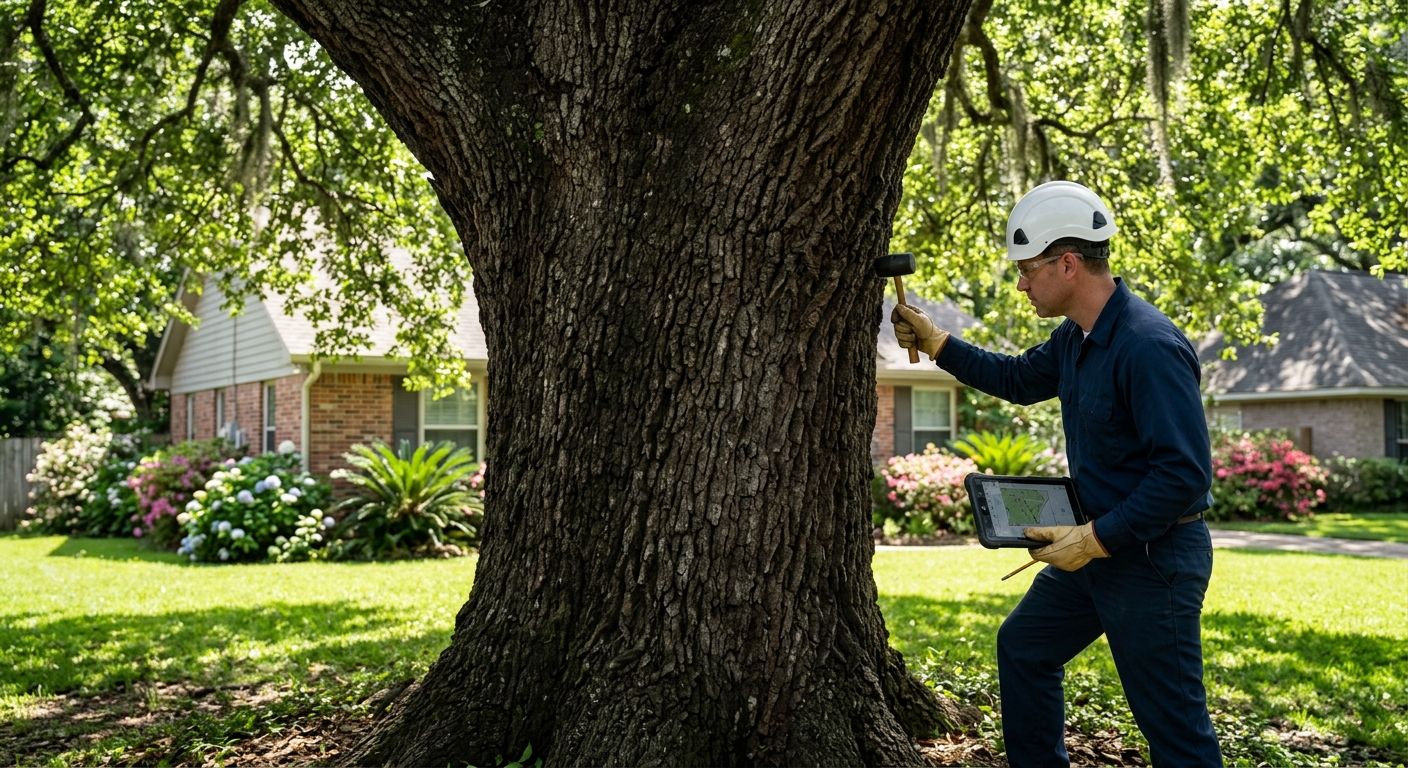
Certified arborists earn credentials through the International Society of Arboriculture (ISA) and must complete ongoing education to stay current with best practices. Our own team holds ISA Tree Risk Assessment Qualification (TRAQ), which enables us to perform a thorough tree risk assessment that goes far beyond a simple visual inspection. General tree care providers rarely offer this level of evaluation, leaving your property vulnerable to undetected hazards. Using systematic methods like visual tree assessment and sounding with a specialized mallet, we detect hidden decay, cracks, or structural weaknesses that untrained workers could easily overlook. We also perform a detailed tree health assessment to diagnose fungal infections, nutrient deficiencies, or pest issues before they threaten your landscape. This proactive approach helps prevent costly property damage and protects the long-term health of your trees.
General tree workers may offer lower upfront rates, but they often lack formal training and may use harmful practices like topping or climbing spikes on healthy trees. According to the LSU AgCenter, unqualified crews frequently appear as storm-chasers after severe weather, putting homeowners at risk. As a local, family-owned and operated company with over 40 years serving Northwest Louisiana, we prioritize safety and quality above all. We are fully licensed and insured, and our A+ rating with the Better Business Bureau reflects our commitment to honest, professional service. Our 24/7 emergency service ensures that when storms strike, you can count on us to provide immediate help. Our arborists follow ANSI A300 pruning standards and never damage trees with improper techniques. Our trained crews use cranes and stump grinders to handle even the most complex removals safely and efficiently.
Whether you need a routine health evaluation or a post-storm damage assessment, a certified arborist consultation is the most reliable way to safeguard your property. Our team takes the time to understand your landscape goals and offers professional, respectful service at every step. Contact us today to schedule a consultation with one of our certified arborists and see the difference expertise makes.
The Components of a Professional Arborist Consultation
When you schedule a certified arborist consultation with Miller Tree Service, a local, family-owned business that has served Northwest Louisiana for over 40 years, you receive a thorough evaluation split into two phases: an initial walkthrough and advanced diagnostics. The table below clarifies the difference between a tree risk assessment and a tree health assessment, both of which are often part of our comprehensive consultation.
Comparison: Tree Risk Assessment vs. Tree Health Assessment
| Aspect |
Tree Risk Assessment |
Tree Health Assessment |
| Primary Purpose |
Identify structural hazards and failure risk |
Evaluate overall vitality and diagnose issues |
| Common Methods |
Visual inspection, sounding, resistograph, load testing |
Foliar analysis, soil testing, pest scouting, lab diagnostics |
| When to Request |
After storms, before construction, for large or decayed trees |
Seasonal checkups, when leaves discolor or growth slows |
| Outcome |
Risk rating (low, moderate, high) and mitigation plan |
Health score, treatment prescription, and follow-up schedule |
| Cost Note |
Custom quote based on tree size and site complexity |
Custom quote based on diagnostic tests needed |
This distinction allows our arborists to pinpoint whether a tree’s primary concern is structural or biological—and tailor our recommendations accordingly. In many cases, we perform both assessments during a single visit to provide a complete picture.
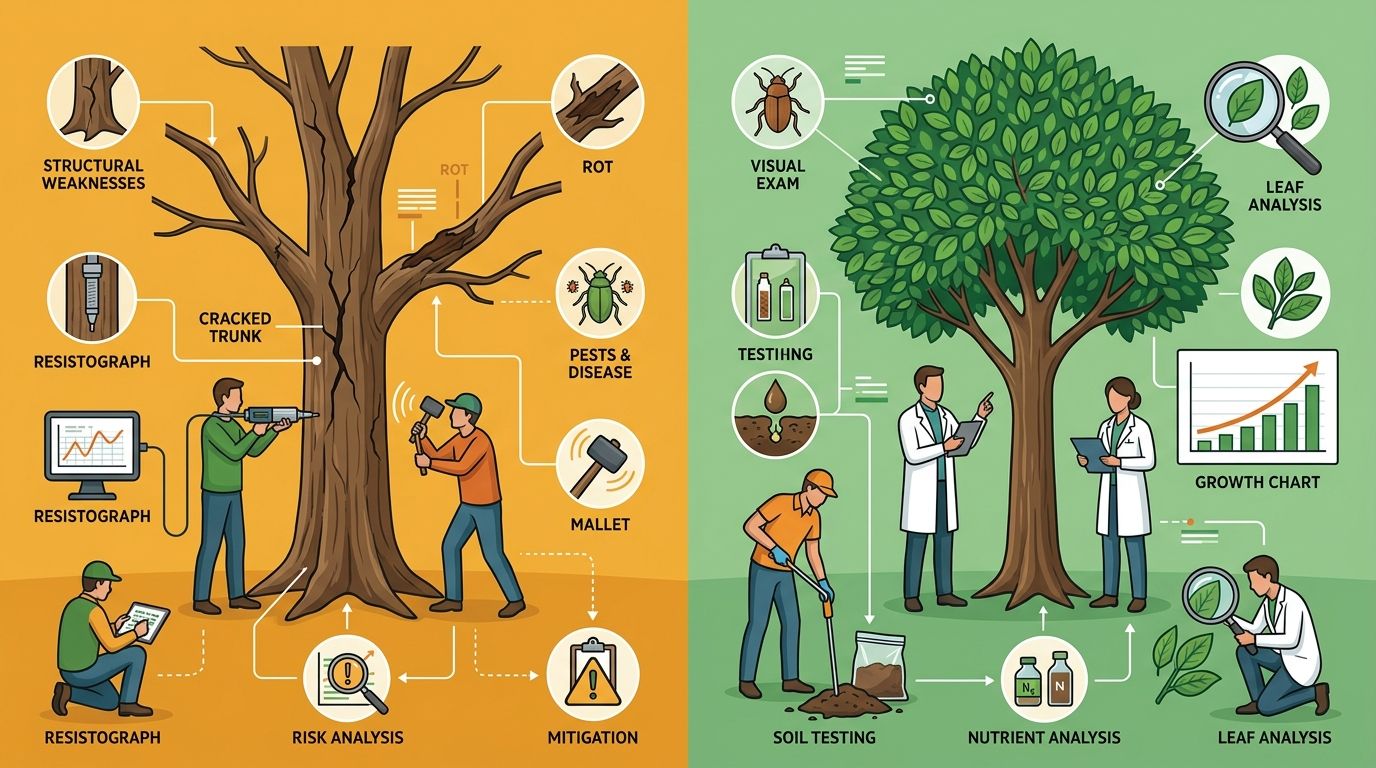
Visual guide comparing tree risk and health assessments for property owners.
Now, let’s walk through the two phases in detail.
Initial Walkthrough and Visual Inspection
We begin each consultation by walking the property with you, observing each tree from a distance before moving closer. Our arborists scan the overall canopy for thinning, discoloration, or unusual growth patterns that suggest stress. We then move in to inspect the trunk and major limbs, looking for cracks, cavities, peeling bark, and fungal fruiting bodies—any of which can indicate internal decay or disease. The root flare and surrounding soil are checked for heaving, mounding, or exposed roots that compromise stability. Dead or hanging branches are noted, and we test limbs for brittleness. Sounding the trunk with a mallet reveals hollow zones; a dull thud warrants deeper investigation. Key items we evaluate include trunk integrity, limb attachment angles, crown density, root plate condition, and proximity to structures, power lines, or driveways. If we spot a lean greater than fifteen degrees or vertical seams in the bark, we flag that tree for a formal tree risk assessment. Our four on-staff arborists bring decades of combined experience to these inspections, recognizing subtle warning signs a less trained eye might miss. By cataloguing each finding, we build a baseline that guides whether a tree needs routine pruning or a full risk assessment.
Advanced Diagnostics and Risk Evaluation
When visual inspection raises red flags—or when you request a comprehensive health check—we progress to advanced diagnostics. This phase often begins with a formal tree risk assessment, a systematic process designed to quantify the likelihood of failure. Our team uses a resistograph, a precision instrument that drills a tiny probe into the trunk to measure wood density. By detecting variations in resistance, the tool maps internal decay depth and extent, confirming whether a cavity is superficial or life-threatening. For a tree health assessment, we collect soil samples from the root zone and send them to a lab for nutrient and pH analysis. Our arborists also scout for pests and diseases, taking tissue samples if needed to identify specific pathogens such as root rot or oak wilt. The results produce a health score and a tailored treatment prescription—whether that involves fungicide injections, soil amendments, or strategic pruning. Based on all findings, we assign a risk rating of low, moderate, or high and develop a mitigation plan that may include cabling, pruning, or removal if necessary. Every recommendation is grounded in ISA best practices and the real-world experience we’ve gained working across Shreveport, Bossier City, and the surrounding parishes. Because each situation is unique, we provide a custom quote for these services, with no one-size-fits-all fees. With our A+ BBB rating and fully licensed, insured status, you can trust that our guidance is honest, accurate, and backed by over 40 years of local service.
With a thorough understanding of what our consultation involves, you can feel confident in the recommendations we provide.
After the Consultation: Understanding Recommendations and Next Steps
Once your certified arborist consultation in Northwest Louisiana is complete, our team compiles the findings into a detailed report. This document becomes your guide for maintaining safe, healthy trees.
Receiving Your Detailed Assessment Report
Your certified arborist consultation provides the foundation for this comprehensive report. It begins with a tree-by-tree summary of species and overall condition, followed by a tree risk assessment in Shreveport that categorizes each tree as low, moderate, or high risk. Specific health diagnoses—whether pests, diseases, or structural defects—are clearly documented, along with recommended treatments ranked by urgency. The custom care recommendations section outlines pruning, treatment, or removal needs, and every report includes a custom quote that reflects the exact scope of work with no hidden fees.
The report immediately flags any safety-critical issues: dead branches, leaning trunks, or recent storm damage. As a fully licensed and insured company with over 40 years serving Northwest Louisiana, we provide 24/7 emergency service to address these hazards without delay.
We encourage you to walk through the report with one of our certified arborists. Our team explains every finding in plain language and answers your questions about the tree health assessment. This conversation ensures you feel confident about the next steps and how they align with your landscape goals. If you have follow-up questions or notice new concerns after reviewing the report, we are happy to revisit your property to provide additional clarity.
Implementing Arborist Recommendations
When you are ready to act, start by addressing safety risks first. High-risk items such as hazardous limbs or unstable trees demand immediate attention. Next, focus on health treatments—fertilization, pest control, or disease management—to resolve underlying issues highlighted in the tree risk assessment. Cosmetic pruning and planting can round out your plan once the most critical work is complete. Our arborists help you prioritize each task so that resources go where they are needed most.
Scheduling is straightforward. Complex removals or large pruning jobs may require multiple visits or specialized equipment, and we coordinate the timeline to fit your schedule. We also guide you through any necessary permits, such as those for public right-of-way trees, and explain each step clearly. If your property has sustained storm damage, we strongly recommend hiring an arborist after storm damage with ISA certification, proper liability insurance, and a verified license—as LSU AgCenter guidelines emphasize. Our team is available 24/7 for emergency call-outs to handle urgent threats from severe weather. We can often be on-site quickly—typically within one to two hours.
Long-term tree health depends on regular monitoring. We offer annual tree health assessments to track changes, adjust care plans, and catch new issues early. Our team can set reminders for follow-up visits so you never miss a critical maintenance window. We also recommend seasonal observations, especially after heavy storms or extreme temperature swings, to identify and address issues before they escalate. Our arborists can adjust the monitoring frequency based on the unique risks identified during your initial tree risk assessment. Proactive monitoring preserves the value and beauty of your landscape year after year.
To help you decide whether to handle tree care yourself or trust the experts, here is a quick comparison of the key differences between DIY efforts and hiring a certified arborist.
Comparison: DIY Tree Care vs. Hiring a Certified Arborist
| Factor |
DIY Approach |
Professional Arborist |
| Expertise |
Limited to basic pruning and observation |
ISA certification, disease diagnosis, risk training |
| Safety |
Risk of injury from falling branches or power tools |
Trained crews, safety gear, liability insurance |
| Equipment |
Basic hand tools, rented equipment |
Industrial saws, cranes, stump grinders, diagnostic gear |
| Cost Consideration |
Lower upfront but may miss hidden issues |
Custom quote; includes assessment, report, and follow-up |
| Long-Term Results |
Variable; no guarantee of tree health or safety |
Evidence-based care plan improves tree lifespan and property value |
While DIY tree care may seem cost-effective upfront, it often misses hidden health issues and exposes property owners to safety risks. As a local, family-owned and operated business with an A+ rating with the BBB, we provide the expertise, insurance coverage, and long-term results that come from over four decades of experience. Choosing a professional team is an investment in the safety and lasting value of your property. Ready to schedule your recommended services? Contact our team or request a service appointment online.
Advanced Arborist Insights: Long-Term Tree Health and Property Protection
Scheduling a certified arborist consultation in Northwest Louisiana is the foundation of proactive tree health management and long-term property protection. Our arborists at Miller Tree Service bring over four decades of local experience to every evaluation, identifying subtle warning signs before they escalate into costly hazards. This expert insight goes far beyond routine trimming, giving homeowners a strategic plan that preserves both tree vitality and the integrity of their property.
A professional tree risk assessment examines structural weaknesses, decay, and environmental stressors that could lead to unexpected failure. During a visual inspection, our ISA-certified arborists look for indicators such as a trunk lean exceeding 15 degrees, vertical cracks, or soil heaving around the root zone. Each tree receives a risk rating—low, medium, or high—based on these findings, helping homeowners prioritize necessary action. By catching these issues early, you can avoid emergency removals and reduce liability for damage to structures, vehicles, or passersby.
Long-term tree health depends on consistent, expert care rather than reactive fixes. A regular tree health assessment allows us to track changes in canopy density, root condition, and pest activity over time. Here are key indicators our arborists routinely evaluate:
- Included bark—a weak union where two stems grow too closely together, prone to splitting during storms.
- Codominant stems—competing leaders that compromise central stability and increase break-off risk.
- Crown dieback—progressive branch death from disease, root stress, or insect infestation.
- Soil compaction—restricted root growth caused by heavy foot traffic or nearby construction, reducing water and nutrient uptake.
Beyond spotting threats, proactive care enhances your landscape’s value. Our arborists design customized maintenance schedules that blend seasonal pruning, soil amendment, and, when necessary, cabling to reinforce weak branch unions. For Northwest Louisiana’s common species like pines and oaks, crown thinning during the dormant season removes 10 to 20 percent of interior branches, improving light penetration and air circulation while lowering the risk of fungal diseases such as oak wilt and anthracnose. This forward-looking approach extends tree lifespan, boosts curb appeal, and protects your investment year after year.
As a fully licensed and insured business with an A+ BBB rating, Miller Tree Service has safeguarded properties across Shreveport, Bossier City, and the surrounding region for over 40 years. Our four on-staff arborists, supported by 24/7 emergency response, deliver reliable guidance tailored to local climate conditions. We treat every client’s property with the same care we extend to our own.
Understanding these principles, you may wonder when professional action becomes urgent—that’s where our 24/7 emergency services come into play. As a local, family-owned and operated company, we are always here to help you protect what matters most. Contact us to schedule a personalized tree health evaluation and begin your custom care plan today.
Frequently Asked Questions About Arborist Consultations
If you’re considering a certified arborist consultation, here are answers to common questions from Northwest Louisiana property owners.
What does an arborist consultation include?
Our arborists inspect tree health and structure during a 30-60 minute visit. You’ll get a written report and can schedule services immediately.
What is the difference between a tree risk assessment and a tree health assessment?
During a tree risk assessment, we look for structural defects like cracks, decay, or leaning that could lead to failure.
During a tree health assessment, we examine the tree’s overall vitality, checking for disease, pests, and environmental stress to guide treatment.
What does a certified arborist consultation typically cost?
We provide free, custom quotes. As a fully licensed, insured, A+ BBB-rated, family-owned business with over 40 years of local service, we’ll tailor a plan. Contact us.
Take the Next Step for Your Trees with Miller Tree Service
Now that you understand the value of proactive tree care, schedule a certified arborist consultation with our team today. We provide thorough tree risk assessments and tree health assessments, recommended by LSU AgCenter, to identify hazards before they become emergencies. Our four on-staff arborists deliver expert evaluations that safeguard your property.
With over 40 years serving Northwest Louisiana as a local, family-owned business, we are fully licensed, insured, and hold an A+ rating with the BBB. Our 24/7 emergency service ensures rapid response after storms. Contact Miller Tree Service for a personalized quote—our team is ready to help protect your landscape.
This article was researched and written with the assistance of AI tools.
Resources