Table of Contents
Bacterial Leaf Scorch in Louisiana: What Tree Owners Need to Know
Among the most damaging tree diseases in Louisiana is bacterial leaf scorch, an incurable condition caused by Xylella fastidiosa. Our tree diseases in Louisiana FAQ covers common risks, but oak trees are the primary hosts for this bacterium, exhibiting xylella fastidiosa symptoms like marginal leaf browning that progresses inward and upward. This pattern differs from drought stress, and without treatment, you may see oak tree branch dieback as the disease spreads. While bacterial leaf scorch cannot be cured, professional tree health management can slow its progression. Accurate diagnosis requires a certified arborist, and with over 40 years of experience, our family-owned team is ready to help. Contact us for an assessment if you notice these signs—early recognition is key to protecting your trees.
Bacterial Leaf Scorch Across Northwest Louisiana
Bacterial leaf scorch louisiana is a chronic and incurable disease caused by the pathogen Xylella fastidiosa. This bacterium invades the water-conducting tissues of susceptible trees and is particularly aggressive in the hot, humid climate of Northwest Louisiana. As the LSU AgCenter notes, oak tree branch dieback symptoms are among the first warning signs in mature red oaks and live oaks.
The following table summarizes how bacterial leaf scorch affects three common Northwest Louisiana trees:
Comparison of Bacterial Leaf Scorch in Common Louisiana Trees
| Tree Species |
Symptoms |
Susceptibility |
Management Options |
| Oak |
Leaf scorch starting at leaf margins, branch dieback, overall decline over several years. |
High susceptibility, especially in red oaks and live oaks. |
Pruning dead branches, maintaining tree vigor, antibiotic injections in early stages, professional diagnosis. |
| Sycamore |
Irregular brown blotches on leaves, premature leaf drop, twig dieback. |
Moderate to high susceptibility; symptoms often appear in mid-summer. |
Leaf scorch treatment via proper watering, mulching, and pruning; professional consultation for severe cases. |
| Maple |
Scorched leaf margins, yellowing between veins, early autumn coloration, branch dieback. |
Moderate susceptibility; stressed trees more affected. |
Maintain soil moisture, avoid root damage, prune affected branches, consider antibiotic treatment. |
Managing bacterial leaf scorch in Louisiana requires a multi-year commitment to tree health. Our certified arborists at Miller Tree Service, who have served Northwest Louisiana for over 40 years, stress that early detection and proactive care can significantly slow disease progression. For high-value oaks and sycamores, trunk-injected antibiotics may offer temporary relief, though they are not a cure. By combining these approaches, we help clients maintain the beauty and safety of their landscapes for as long as possible.
The International Society of Arboriculture also recommends cultural practices to reduce stress: deep watering during dry spells, proper mulching, and strategic pruning of dead or dying branches. These steps help trees resist secondary pests and maintain structural integrity even as the scorch advances.
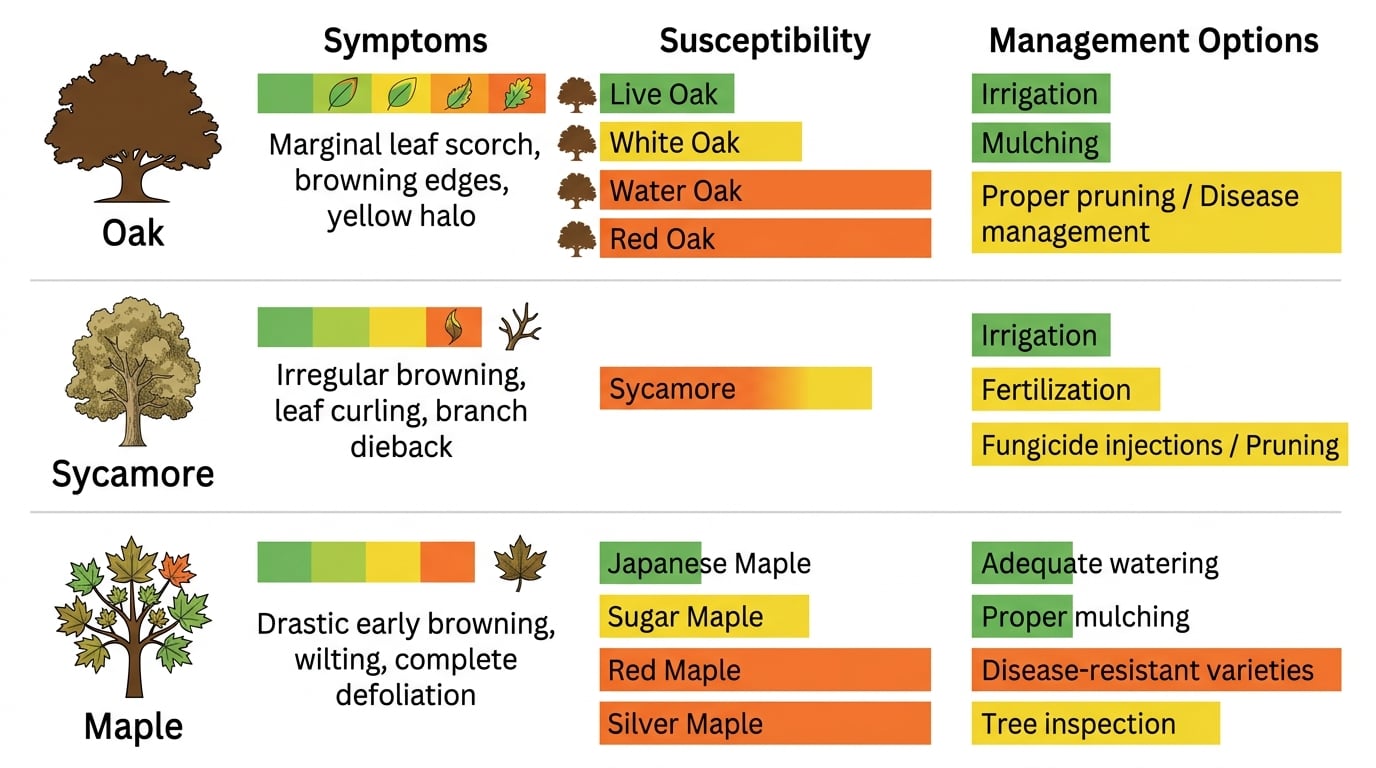
Quick-reference infographic for bacterial leaf scorch in oak, sycamore, and maple trees.
Because symptoms of bacterial leaf scorch often resemble drought stress or nutrient deficiency, accurate diagnosis demands a trained eye. Our team at Miller Tree Service combines local knowledge with advanced assessment tools to confirm the presence of Xylella fastidiosa and design a management plan that fits your landscape. Contact us to schedule a consultation and learn how we can help preserve the health of your trees.
Professional Diagnosis and Treatment Services for Bacterial Leaf Scorch
As bacterial leaf scorch in Louisiana continues to spread through our region’s urban and natural forests, professional diagnosis becomes essential for protecting valuable trees. The symptoms of this disease — caused by Xylella fastidiosa — mimic drought stress and other conditions, so a trained eye is critical. Our ISA-certified arborists at Miller Tree Service conduct thorough visual inspections, examining leaf scorch patterns, evaluating crown density, and documenting branch dieback. When we suspect Xylella fastidiosa symptoms, we recommend laboratory confirmation through ELISA or PCR testing to verify the presence of the pathogen.
The diagnostic process guides our treatment recommendations. For infected trees, we offer several management options:
- Oxytetracycline antibiotic injections administered by our certified arborists to suppress bacterial populations
- Tree health maintenance programs that reduce environmental stress through mulching, watering, and soil management
- Structural pruning to remove dead or declining limbs and improve canopy architecture
It’s important to understand that we frame bacterial leaf scorch as a chronic condition requiring ongoing management rather than a one-time cure. Treatment success depends on several factors including tree size, infection severity, and overall tree vigor. Multiple treatments over consecutive years are often necessary to maintain tree health. For effective bacterial leaf scorch management, working with experienced professionals who understand local conditions is essential.
Oak tree branch dieback is a key indicator we watch for during assessments. In oak species, progressive dieback often begins in the upper crown and spreads downward over multiple growing seasons. Early intervention gives us the best opportunity to preserve structural integrity and extend the tree’s useful life in your landscape. Our team, fully licensed and insured with over 40 years serving Northwest Louisiana, provides the expertise needed to navigate this complex disease. Contact us for a custom quote tailored to your property’s specific needs.
Local Factors Affecting Bacterial Leaf Scorch in Louisiana
Bacterial leaf scorch in Louisiana is a persistent and progressive disease caused by Xylella fastidiosa, a bacterium that thrives in our state’s warm, humid climate. The pathogen colonizes the xylem, or water-conducting tissue, of susceptible trees, blocking water transport and triggering the characteristic leaf scorch symptoms and eventual oak tree branch dieback. In our experience as fully licensed arborists, the long, hot summers of Northwest Louisiana create a near-ideal environment for the disease to establish and slowly intensify over several seasons.
Many of our region’s most iconic oak species are highly vulnerable. The LSU AgCenter has documented how live oaks, water oaks, and willow oaks across the state frequently exhibit Xylella fastidiosa symptoms, including an irregular browning of leaf margins that begins in late summer. Branch dieback tends to appear dieback begins on scattered limbs, often progressing over three to five years until the canopy is noticeably thinned. Drought stress compounds the issue, weakening trees already fighting to move sufficient water through compromised tissues.
The disease spreads locally through xylem-feeding insects such as leafhoppers and spittlebugs. These vectors are abundant in Louisiana, transmitting the bacterium as they feed, but early detection remains critical. Recognizing subtle Xylella fastidiosa symptoms before widespread dieback occurs gives property owners a window to consult an arborist and explore tree leaf scorch management practices designed for long-term tree health.
Steps to Protect Your Trees from Bacterial Leaf Scorch
After identifying symptoms, implementing effective protection strategies is essential. Recognizing bacterial leaf scorch in Louisiana is the first step; taking protective action is the next. When oak tree branch dieback or other xylella fastidiosa symptoms appear, proactive management can help slow disease progression. Bacterial leaf scorch is one of the most common tree diseases in Louisiana that we help property owners manage.
We recommend these protective steps:
- Prune infected branches during dry weather to reduce bacterial spread.
- Avoid overhead watering and improve soil drainage to limit leaf wetness.
- Apply antibiotic injections such as oxytetracycline, as recommended by a certified arborist.
- Maintain overall tree vigor with proper fertilization and mulching.
- Plant resistant oak species, like live oak or southern red oak, where possible.
- Seek a professional tree health assessment from our certified arborists for severe or recurring cases.
Managing bacterial leaf scorch in Louisiana requires ongoing attention from experienced professionals. When preventive measures aren’t enough, advanced treatments—discussed in the next section—can provide further relief. As a family-owned and operated company with over 40 years of experience, Miller Tree Service’s team is fully licensed and insured, offering expert tree health assessments and treatment plans. With an A+ rating from the BBB, we are proud to serve homeowners across Northwest Louisiana. Contact us to schedule a consultation with one of our certified arborists.
Protecting the Trees of Northwest Louisiana
In Northwest Louisiana, bacterial leaf scorch in Louisiana poses a severe threat to live oaks and red oaks. This disease, caused by Xylella fastidiosa and spread by xylem-feeding insects, produces xylella fastidiosa symptoms like leaf scorch and progressive oak tree branch dieback. Among the most damaging tree diseases in Louisiana, it demands prompt action.
We offer thorough tree health assessments to catch bacterial leaf scorch in Louisiana early. Our family-owned, fully licensed and insured team has served the region for over 40 years, bringing expert care to every job. Proper diagnosis can make all the difference for your oaks.
Resources