Table of Contents
Managing Crape Myrtle Bark Scale in Northwest Louisiana
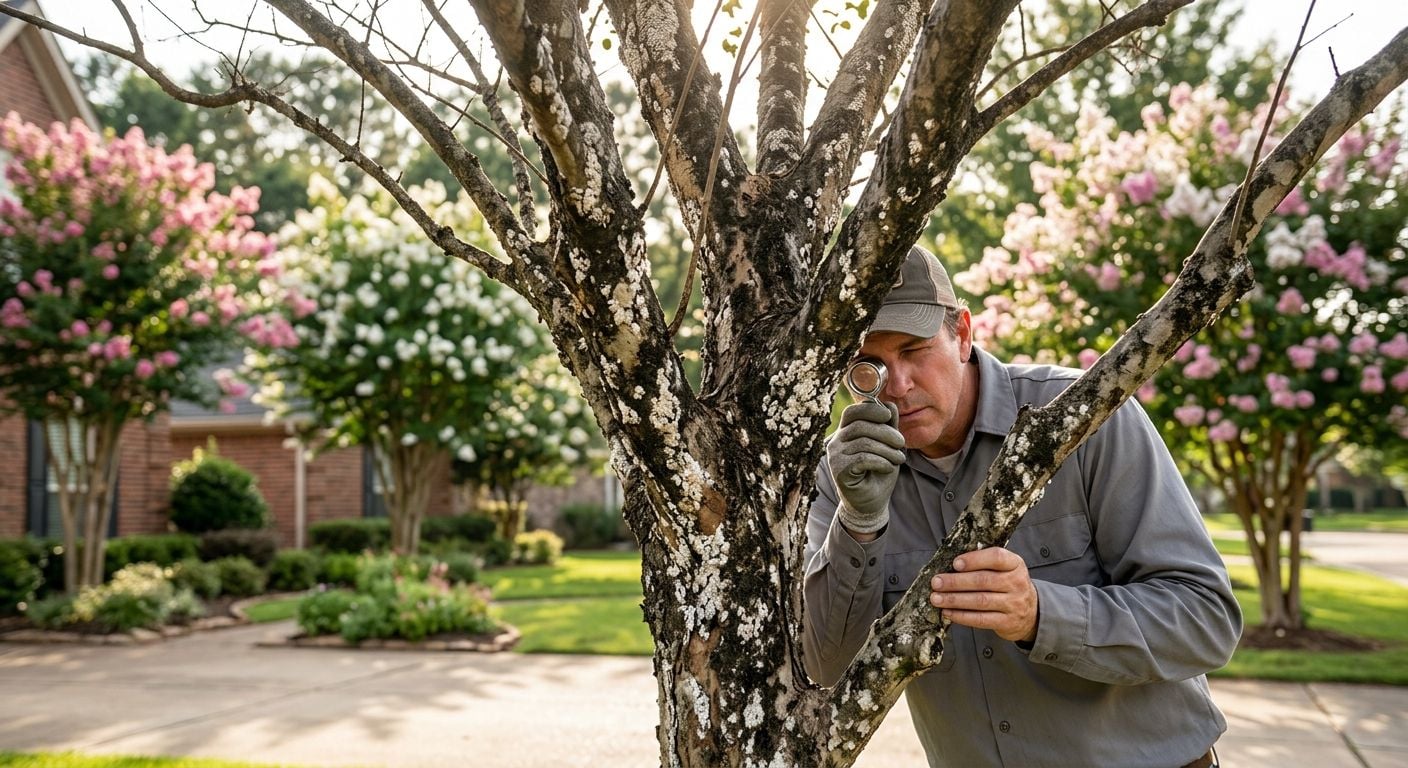
Finding the right crape myrtle bark scale treatment is a common challenge for property owners across our region because this pest thrives in the warm, humid conditions of Northwest Louisiana. These small, invasive insects reveal themselves through distinct white, waxy excretions that cling to the branches and trunks of crape myrtles. Without intervention, an infestation leads to black sooty mold control issues—a dark, sticky fungus that grows on the sugary residue the scale insects leave behind. According to the LSU AgCenter, this mold gradually coats the leaves, blocking sunlight and interfering with photosynthesis, which weakens the tree over time and reduces its vibrant summer blooms.
In our experience, successful CMBS management relies on an integrated approach that combines several methods at the right times of year. Miller Tree Service recommends a multi-step plan that starts with mechanical and cultural controls:
- Prune and dispose of heavily infested branches during the dormant season to immediately reduce the pest population.
- Scrub the bark with a soft brush and mild soapy water to remove the waxy protective coating from the scale.
- Apply dormant horticultural oil in late winter to smother overwintering nymphs before they become active.
- Use a systemic imidacloprid soil drench around the root zone in early spring, which the tree absorbs and transports to the canopy where it targets actively feeding scale.
Timing is critical for effective crape myrtle bark scale treatment. The dormant oil must be applied before buds break in late winter, while the imidacloprid soil drench works best when the tree’s sap is rising in early spring. With over 40 years serving Northwest Louisiana, we have seen that early detection and proper seasonal timing make the difference between a tree that recovers fully and one that continues to decline. Our staff arborists can assess the severity of an infestation and recommend a tailored plan that restores your crape myrtles to health. While scale is a primary concern, local landscapes also face other serious threats, including bacterial leaf scorch in Louisiana, which can affect a wide range of shade trees.
Understanding Crape Myrtle Bark Scale and Its Impact
Crape myrtle bark scale is an invasive pest that has become a significant concern for homeowners and property managers across the Southern United States. Understanding this insect is the first step toward effective crape myrtle bark scale treatment, and early identification can prevent long-term damage to these beloved ornamental trees. As a trusted tree care provider with over 40 years serving Northwest Louisiana, we at Miller Tree Service have seen firsthand how quickly infestations can escalate when left unaddressed.
CMBS feeds on the sap of crape myrtle branches and trunks, weakening the tree over successive seasons. The insect secretes a sticky substance called honeydew, which coats the bark and leaves, creating the perfect environment for a secondary fungal issue known as sooty mold. While the mold itself does not directly harm the tree, it blocks sunlight from reaching leaf surfaces, reducing photosynthesis and compounding the stress caused by the scale infestation. Our team of arborists regularly encounters this combination of symptoms throughout the Shreveport and Bossier City areas, and understanding what you are looking at is essential for protecting your landscape investment.
Identifying Bark Scale on Crape Myrtles
The most distinctive sign of a CMBS infestation is the presence of white, waxy crusts along the branches and trunks of the tree. These patches are actually clusters of adult female scales and their egg masses, and they can easily be mistaken for lichen or other natural bark growths at a glance. Unlike bacterial leaf scorch in Louisiana, which causes leaf browning and decline, CMBS leaves a telltale white residue that is unique to this pest.
A closer inspection reveals pinkish or reddish fluid when the white crust is crushed, which confirms the presence of living scale insects rather than harmless lichen. This simple test helps differentiate CMBS from other common crape myrtle issues like powdery mildew, which appears as a white dusting on leaves rather than on woody tissue. According to LSU AgCenter guidance, the honeydew excretion also attracts ants and wasps, which feed on the sugary substance and can serve as an additional visual cue that an infestation is active.
The black sooty mold that follows the honeydew is often the symptom that first draws a property owner’s attention. While many people seek black sooty mold control solutions, it is important to recognize that the mold is a secondary problem — the underlying scale infestation must be addressed for any lasting improvement.
Life Cycle of the Crape Myrtle Bark Scale
The life cycle of CMBS in Louisiana follows a predictable seasonal pattern that we encourage our clients to learn, because monitoring at the right time of year makes detection far easier. Adult females overwinter on the bark and produce pinkish egg masses in early spring, typically as temperatures begin to warm in March and April. These eggs hatch into tiny mobile nymphs called crawlers, which emerge in large numbers during May and June.
The crawler stage is the most vulnerable point in the scale’s life cycle, because the insects have not yet developed their protective waxy coating. During this brief window, they move along the branches seeking suitable feeding sites, and they can be spread by wind, birds, or even gardening tools to nearby crape myrtles. Once the crawlers settle and begin feeding, they molt into the adult stage and develop the characteristic white crust that protects them from many environmental threats and contact-based treatments.
By midsummer, a second generation may be active, making the pest a persistent presence through the growing season. Understanding this timing helps property owners plan inspections and interventions to coincide with peak crawler activity.
Why Early Intervention Matters
Catching a scale infestation in its earliest stages offers the best chance of preserving the health and beauty of your crape myrtles. When left untreated, the continuous sap-feeding deprives the tree of essential nutrients, leading to twig dieback, stunted new growth, and noticeably fewer blooms over consecutive years. In our experience serving communities from Benton to Mansfield, we have observed that trees under heavy stress from CMBS become more vulnerable to other environmental pressures, including drought and secondary disease.
The black sooty mold that coats the leaves further suppresses vigor by blocking the sunlight needed for photosynthesis. A heavily infested tree may still survive for several seasons, but it will gradually decline in form and floral display. Annual monitoring in spring, when overwintering adults become visible and crawler emergence begins, is a simple practice that can spare property owners the frustration of watching a once-thriving crape myrtle slowly deteriorate.
Once you identify the scale, the next step is choosing an effective treatment approach, which we cover in the following section.
Disclaimer: This information is provided for educational purposes only. For a definitive diagnosis and treatment plan tailored to your specific trees, please consult a certified arborist.
Benefits of Professional Treatment for Infested Crape Myrtles
When crape myrtle bark scale takes hold, the damage goes beyond a simple cosmetic flaw. These insects drain vital sap, leading to thinning canopies, reduced flowering, and the black, sticky mess of sooty mold. Recognizing an infestation is the first critical step, but acting with professional crape myrtle bark scale treatment is the pivotal move that determines whether a beloved tree thrives or declines. For property owners in Northwest Louisiana, our team at Miller Tree Service delivers this definitive care, transforming severely infested trees back into vibrant landscape assets through proven methods.
Restoring Tree Health and Appearance
Bringing an infested crape myrtle back begins by precisely breaking the scale’s lifecycle, an approach our arborists tailor using methods like an imidacloprid soil drench. This systemic solution is absorbed by the roots and moves upward through the tree, targeting the feeding scale from the inside out with minimal environmental impact. The payoff is a dramatic reversal of decline, where lush, new growth replaces spindly branches, and the tree’s capacity for spectacular blooming is fully restored.
Concurrently, we tackle the unsightly aftermath. The black sooty mold that develops on honeydew-coated branches will gradually weather and flake away once the insect source is eliminated. Our treatment strategy goes beyond simple black sooty mold control; it rejuvenates the tree’s aesthetic by allowing the natural, exfoliating cinnamon-colored bark to re-emerge. This comprehensive restoration of both health and appearance reinforces why professional scale treatment provides results far beyond what over-the-counter remedies can achieve.
Preventing Spread to Nearby Trees
An untreated infestation acts as a launch point, allowing crawlers to migrate on birds, wind, or gardening tools to nearby crape myrtles and other ornamentals. Professional bark scale management stops this threat at its source, creating a protected zone around your landscape investments. Our targeted protocols not only contain the immediate outbreak but also fortify treated trees, making them far less susceptible to reinfestation from neighboring properties.
This proactive shield extends to safeguarding against a range of threats that weakened trees can encounter. Professional care also helps prevent other issues such as bacterial leaf scorch in Louisiana, a separate but serious condition that can mimic scale damage. By maintaining robust tree vitality through expert intervention, we help ensure your entire yard’s ecosystem remains resilient against a spectrum of pests and diseases.
Long-Term Value of Professional Care
Timely professional crape myrtle bark scale treatment is a strategic investment that preserves far more than just branches and blooms. Mature crape myrtles add significant structure and beauty to a property, and losing them to a preventable infestation leads to high removal and replacement costs. Opting for our custom-quote treatment plans is a clear choice for long-term savings, safeguarding your mature trees and avoiding the disruption and expense of extraction from your landscape.
Spanning over 40 years in Northwest Louisiana, we have seen how healthy, mature trees directly enhance curb appeal and property value. Our long-term care strategy, rooted in advanced arboricultural research, focuses on extending the life of your crape myrtles well beyond the current season. Regular monitoring and maintenance by certified professionals prevent recurrent episodes, ensuring these trees remain a source of beauty, not a recurring budget concern, for decades to come. In our next section, we detail the specific methods and timing we use to deliver these lasting results.
How Crape Myrtle Bark Scale Treatments Work
Once you have confirmed a crape myrtle bark scale infestation, the next step is choosing an effective crape myrtle bark scale treatment plan. As a family-owned and operated tree service with over 40 years serving Northwest Louisiana, Miller Tree Service understands that successful scale control requires a strategic approach rather than a single application. The right method depends on the severity of the infestation, the time of year, and whether you prefer chemical or organic solutions. Proper identification is essential before selecting any crape myrtle scale control method, as other issues like drought stress or leaf spot diseases can mimic scale damage symptoms, according to LSU AgCenter research.
Systemic Insecticides: Imidacloprid Soil Drench
A widely recommended CMBS treatment is the imidacloprid soil drench, which works by leveraging the tree’s natural vascular system. When you apply this systemic insecticide around the root zone, the active ingredient is absorbed by the roots and translocated upward through the sapwood. As scale insects feed on the nutrient-rich sap, they ingest the insecticide and die. The soil drench method is typically applied in early spring or fall, allowing adequate uptake time before peak scale activity. One critical precaution is protecting pollinators — imidacloprid can move into flower tissues, so treatments should be timed outside the blooming period. Research from LSU AgCenter confirms that systemic applications reach feeding scales that contact insecticides cannot, making this approach particularly valuable for heavy infestations where thorough coverage is difficult to achieve with sprays. Consistent treatment across multiple seasons may be needed for complete control, as egg hatch and crawler activity can reintroduce the pest even after initial knockdown.
Organic and Low-Impact Control Methods
For property owners seeking a crape myrtle bark scale organic treatment, several effective options target the insect without synthetic chemicals. Horticultural oils work by coating and suffocating scale insects, and they are most effective when applied during the dormant season or against young nymphs before protective wax layers form. Insecticidal soaps disrupt cell membranes on contact, while neem oil provides both insecticidal and antifeedant properties that can reduce scale feeding over time. Biological controls also play a role in an integrated approach — beneficial insects like ladybugs and parasitic wasps naturally prey on scale populations, especially when you avoid broad-spectrum pesticides that harm these allies. Miller Tree Service advises that while organic methods are environmentally gentle, they often require more frequent application and diligent monitoring to achieve results comparable to systemic treatments. Early intervention is key, as small infestations respond far better to low-impact controls than established, heavy populations.
| Treatment Type |
Primary Method |
Best Application Window |
| Systemic Control |
Soil Drench (Imidacloprid) |
Early Spring (Pre-bloom) |
| Dormant Control |
Horticultural Oils |
Late Winter (Dormancy) |
| Crawler Targeting |
Foliar Sprays/Soaps |
Late Spring to Early Summer |
It is also important to understand that black sooty mold is a secondary symptom caused by the honeydew that scale insects excrete, not a disease attacking the tree directly. Effective black sooty mold control therefore depends on eliminating the scale population that produces the honeydew. Once the insects are gone, the mold gradually weathers away or can be washed off by rain, though severely coated branches may benefit from light pressure washing.
Professional vs. DIY Application Considerations
When comparing professional arborist treatments with DIY applications, safety and efficacy should guide your decision. Fully licensed and insured professionals at Miller Tree Service have access to commercial-grade products and the training to apply them at precisely the right time in the pest’s life cycle. Our arborists understand local soil conditions and tree physiology, reducing the risk of over-application or environmental harm. DIY soil drenches and sprays offer a lower upfront cost but carry significant risk of misapplication — incorrect dosing can fail to control the scale while exposing beneficial insects and pollinators to unnecessary chemicals. Additionally, climbing or using ladders to treat tall crape myrtles poses safety hazards that professional crews are equipped to handle. Miller Tree Service maintains an A+ rating with the BBB, reflecting our commitment to professional and respectful service across Shreveport, Bossier City, and surrounding communities. Contact Miller Tree Service today for a free estimate on a customized crape myrtle bark scale treatment plan tailored to your landscape’s needs.
Whether you choose systemic insecticides, organic controls, or professional application, the key to success is persistence. Scale insects are resilient, and even the most effective treatments may require follow-up applications across multiple seasons to achieve lasting crape myrtle scale control. We encourage you to reach out to our team for expert guidance on protecting your valuable ornamentals.
Best Practices for Ongoing Crape Myrtle Health
Once you’ve identified a crape myrtle bark scale infestation on your trees, the focus must shift to long-term management strategies tailored to our unique Louisiana climate. Effective crape myrtle bark scale treatment requires a well-timed, multi-pronged approach that addresses the pest at every stage of its lifecycle. As a family-owned business with over 40 years of experience serving Northwest Louisiana, we’ve developed a deep understanding of how to combat this persistent pest using methods recommended by both our certified arborists and the LSU AgCenter.
Optimal Treatment Timing in Louisiana
The most critical factor in successful treatment is timing. For systemic control, our team recommends applying an imidacloprid soil drench in early spring, as new growth begins to emerge. The LSU AgCenter notes that this method allows the tree to uptake the active ingredient through its roots, distributing it throughout the canopy to target scale as they feed. This early window ensures the insecticide is fully systemic before the primary crawler stage begins.
A second, equally important phase involves a foliar spray application during the crawler stage, which typically occurs from late spring into early summer in Louisiana. At this point, the immature scale insects are mobile and vulnerable on the bark’s surface, making them susceptible to direct contact with horticultural oils or insecticides. By combining a spring soil drench with a targeted summer foliar spray, you create a comprehensive defense that disrupts the pest’s lifecycle and provides season-long protection for your crape myrtles.
Monitoring and Early Detection Tips
Consistent monitoring is your first line of defense. We recommend inspecting your crape myrtle bark on a monthly basis, paying close attention to any white, waxy secretions—these are the protective shells of the female scales. Another clear indicator is the presence of sticky honeydew, which these pests excrete onto leaves and branches. This substance often leads to a secondary fungal infection known as black sooty mold. The sight of black sooty mold control challenges on leaves and trunks is a reliable early warning sign that a bark scale population is actively feeding above.
If you notice any of these symptoms, take note of the infestation’s severity. For light, isolated patches, a targeted scrub with soapy water can be an effective mechanical control. However, if the infestation is widespread or returning, it’s time to seek a professional evaluation. Our arborists can accurately diagnose the pressure level and provide a customized treatment plan to prevent irreversible damage from what can quickly become a fatal condition for an otherwise healthy tree.
Integrated Pest Management for Long-Term Control
Truly sustainable health for your crape myrtles comes from Integrated Pest Management (IPM), a holistic strategy that goes beyond chemical treatments. This begins with diligent cultural practices. Proper irrigation, especially during our hot, dry summers, and annual structural pruning improve air circulation within the canopy, making the environment less hospitable for pests and fungal diseases alike.
Biological controls also play a vital role. We always advise preserving beneficial insects like lady beetles and lacewings, which are natural predators of scale insects. When insecticide use becomes necessary, select solutions should be chosen strategically to minimize impact on these helpful allies. As a fully licensed and insured provider, we integrate these methods into annual tree health assessments conducted by our four on-staff arborists, ensuring any signs of re-infestation are caught early. A professional, holistic management routine is the most reliable way to preserve the beauty and value of your trees. If you’re concerned about bark scale or any other tree health issue in Shreveport or Bossier City, contact us today for a customized assessment and custom quote.
Protecting Your Crape Myrtles with Expert Care
When bark scale strikes, effective crape myrtle bark scale treatment demands a professional touch. As a local, family-owned operation with over 40 years serving Northwest Louisiana, our team diagnoses infestations early—spotting the sticky honeydew, black sooty mold, and branch dieback that signal trouble—before they permanently weaken your trees. Our timely assessments often catch infestations while they are localized, making treatment more effective and less invasive.
We design tailored crape myrtle bark scale treatment plans that combine systemic solutions like an imidacloprid soil drench with ongoing black sooty mold control. This integrated approach halts the pest lifecycle and lets your crape myrtles regain their natural vigor. Because we employ four licensed arborists and are fully licensed and insured, you get care built on decades of hands-on experience rather than guesswork.
Early intervention stops bark scale from stealing years off your landscape. Contact our Shreveport office today for a custom evaluation—our arborists will outline a clear, professional path to restore your trees’ health. We also offer follow-up inspections to monitor recovery and adjust treatments as needed to prevent recurring outbreaks during the growing season.
Resources